

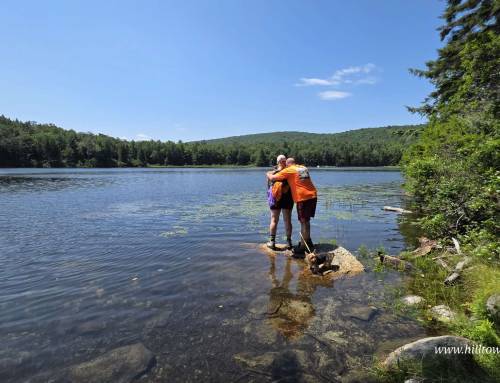
Savoy’s Bog Pond (elevation 1,858 feet 40 acres in size) was dammed up in the 1800s to provide power for sawmills downstream. In 1937, the Civilian Conservation Corps (CCC) built the concrete dam which currently remains. At times, beavers further enhance the impoundment and build on top of the concrete dam.
The brown-colored water in Bog Pond is acidic from dissolved, decomposing organic matter. Sphagnum moss removes mineral content from the water and gives off hydrogen ions, reducing the pH, making the water even more acidic. This slows down as decomposing vegetation causing the layers of dead plant material to add up over time. This bog has an inlet and an outlet which allows water to circulate through, increasing the decomposition of organic matter and slowing the formation of the bog.
A bog is a type of wetland accumulating dead plant material, mostly sphagnum moss, over hundreds to thousands of years. Bogs are generally found in cool, temperate, northern hemisphere climates. This is a quaking bog; conditions are right for floating mats of vegetation to grow over the surface of the pond. In the past, these mats have been seen to move from place to place according to the winds, but they are stationary today. Over time, if undisturbed by humans or beavers, these mats could completely cover the pond’s surface. Courtesy DCR
See all our events, maps, blog and photos at www.hilltownhikers.com please donate, we are 100% funded by you! Join our membership community and take part in our adventures every weekend! https://westernmasshilltownhikers.com/donate/ venmo @hilltownhikers we are certified and insured mass 501c3 non-profit organization
Western Mass Hilltown Hikers Visit Massachusetts Visit the Berkshires of Western Massachusetts #hikethehilltowns with the #westernmasshilltownhikers #hilltownhistory #hikingwithdogs @topfans





Leave A Comment