

One of the great historical sites in Western Mass, the William O. Bassett Charcoal Kiln, 1870 at Kenneth M. Dubuque Memorial State Forest in Hawley.
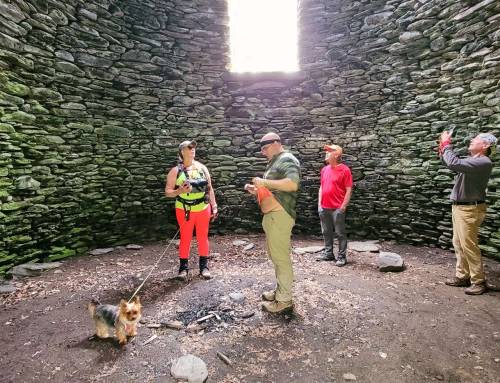
A UNIQUE STRUCTURE This beehive-shaped fieldstone charcoal kiln is unusual for New England, and unique that it is the oldest remaining example in the region. This site is listed on the National Register of Historic Places, East Hawley Center Historic District (1992). This kiln was built in 1870 by Albert Dyer of Plainfield for William D. Bassett, who was Hawley’s most successful farmer at the time and lived nearby. The kiln is 25 feet high, 25 feet in diameter, and burned up to about 35 cords of wood at a time.
Charcoal is wood not completely burned. Charring (pyrolysis or carbonization) takes place when air (oxygen) is gradually removed during a burn, avoiding open flame combustion (exothermic reaction). The resulting charcoal is at its carbon essence and when burned as a fuel, provides a slow, high heat (up to temperatures of 4,800° F), ideal for iron making and blacksmithing.
In 1800s America charcoal was a profitable industrial commodity, in addition to being a fuel source, it was used to make potash and had many other applications. Making charcoal was a labor intensive and time consuming process. Hundreds of acres of forest were required to make charcoal, which afterwards left a barren looking landscape. Wood cutters would first clear-cut all favored hardwood trees. The piles or billets of 4-foot logs were then moved to one or more mound kiln sites where the charcoal maker, or collier, went to work. Billets were systematically stacked on a 30-40 foot wide level spot and covered with leaves and dirt then slowly burned. After the burn the charcoal was uncovered, measured in bushel baskets into a high sided wagon and transported by teamster to the industry.
Mound kilns sites were temporary, used as long as the source of hardwood remained nearby, twice, maybe three times. But this permanent stone conical kiln was used many times between 1870-c1900. This type of kiln was deemed the most efficient design to burn charcoal. Wood was brought here from remote cuts, stacked inside through the lower door, and then completed through the upper door on the rear. The fire was lit at the top and the iron doors were shut. The slow burn to the bottom and outward was controlled by draft holes, plugged with bricks, still visible along the side of the kiln. The burn removed moist bushels of charcoal per burn. In 1880 Massachusetts a bushel of charcoal cost about 10 cents.
A process called “sweating,” usually took over 3-4 days. The complete burn would take up to 10-12 days and nights. The collier was required to be near and vigilantly tend the burn lest it be ruined. Watching for the color of smoke was important. Yellow smoke meant too much air was entering the burn and about to flame up; draft holes needed to be plugged to prevent that. Blue smoke meant the fire was burning just right. The ultimate yield of charcoal depended on the type of wood used. One cord of wood (128 cubic feet) would produce about 30 bushels (37 cubic feet) of charcoal (1890) One bushel equals 8 dry gallons, or 15-22 lbs. (1880, 1900)
Charcoal use and production declined toward the late 1800s as available hardwood forest supplies were exhausted, and the introduction of less costly mineral coal (anthracite and bituminous coke) became more readily available with improved transportation systems. By 1900 the local hardwood sources needed for this kiln had been depleted.
Sitting idle the kiln was repurposed to house livestock. Hawley State Forest was created in 1923 from much of the since abandoned farmland. In 1957 this property was added to the state forest and the kiln restored under Forest Supervisor, Kenneth M. Dubuque, in whose memory Hawley State Forest was later renamed in 1981. The kiln was extensively restored in 1993 through the Hawley Historical Society by contractor Steve Striebel, Tibetan stone mason Sonam Lama and Tenzin Norbu. The last restoration occurred in 2011, replacing stone and removing vegetation.
Nature, weather and careless vandalism continue to be the main threat to preserving this relic of our past agricultural-industrial heritage. Do your part to help protect this site from disappearing.
Western Mass Hilltown Hikers
#hikethehilltownhistory
#hikethehilltowns with the #westernmasshilltownhikers #discoverthehilltowns #visitthehills #hilltownhistory #flashhike #intheberkshires #nature #adventure #history #hiking #outdooradventures #visittheberkshires #mylocalMA #visitma #hilltownhikers #westernmass #hikingwithdogs
Visit our blog for all of our adventures! want to come along on these hikes? Become a member at www.hilltownhikers.com
Help conserve the Chester Granite Saw, our newest property! https://www.pledge.to/help-conserve-the-chester-granite-saw
Text HILLTOWNHIKERS to 707070 to donate.
www.hilltownhikers.com
You can mail your tax-deductible donation to Western Mass Hilltown Hikers, PO Box 3, Chester, MA 01011
Venmo @hilltownhikers
Stay informed – join our mailing list https://lp.constantcontactpages.com/sl/5O0RYN5/hilltownhikeremail





Leave a Reply